
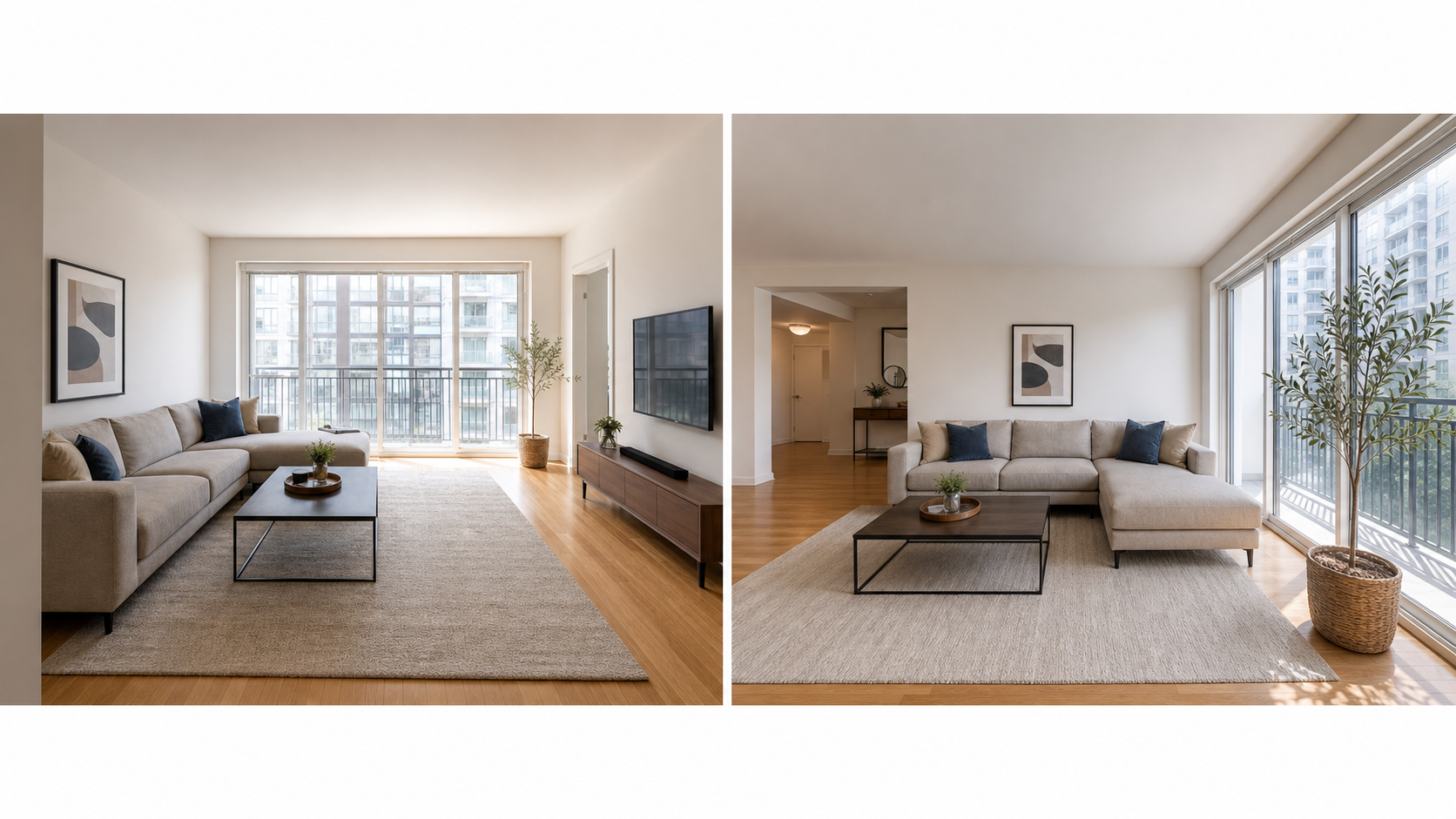
What are the virtual staging disclosure rules in 2026?
Virtual staging is legal and widely used, but in 2026 nearly every serious channel expects it to be disclosed. The consistent baseline across MLSs, portals, and ethics rules is: label the staged image where viewers will see the label, say it again in the listing description, and keep or show the original unstaged photo. California went further with AB 723, which since January 1, 2026 requires licensees to put a conspicuous disclosure on or next to any digitally altered marketing image and provide access to the original through a link, URL, or QR code.
The reason the rules converged is simple: a staged image changes what the property appears to contain. Regulators and platforms treat that as fine to show and unacceptable to hide. Hosts and agents who build labeling into their workflow lose nothing; the listings still look furnished and finished, and no buyer or guest gets surprised.
How do disclosure rules compare across platforms?
The table below summarizes the practical rule for each major channel. Details vary by MLS and state, so treat this as a starting map rather than a substitute for your own MLS's published policy.
| Platform | Virtual staging allowed? | Disclosure practice |
|---|---|---|
| MLS (typical) | Yes | Label on image or in photo description; many MLSs want the unstaged original included; no hiding defects or changing structure |
| California MLSs (AB 723) | Yes | Conspicuous disclosure on or adjacent to the image plus access to the original; CRMLS places the original immediately before or after the altered photo |
| Zillow (for sale) | Yes, via MLS feed | MLS labels and rules carry through syndication |
| Zillow Rental Manager | Use caution | Caption staged images clearly; the unit must match what renters tour |
| Airbnb | Poor fit | Photos must reflect the real stay; staged furniture that will not be present invites accuracy complaints |
| Vrbo | Poor fit | Accuracy expected; note that Vrbo rejects text overlays and watermarks, so on-image labels are not available |
| Booking.com | Poor fit | Photos should show the property guests will receive |
What do MLS rules usually require for staged photos?
Most MLS altered-image policies share four elements. First, a visible label: the word Virtually Staged on the image, in the photo caption, or both. Second, honesty about scope: staging may add furniture and decor to a real room, but may not change walls, windows, flooring, fixtures, views, or condition, and may never conceal defects. Third, originals: many MLSs require or strongly recommend including the unstaged photo of the same room, and CRMLS requires the original immediately before or after the altered image. Fourth, description-level disclosure that survives syndication to portals.
MLS enforcement is administrative: photo removal, correction notices, and member fines depending on the board. The professional risk usually costs more than the fine, because a staging complaint is visible to the client whose listing gets flagged.
What should hosts do on Airbnb, Vrbo, and Booking.com?
Short-stay platforms sell the actual stay, so their photo rules are accuracy rules. Airbnb's help content on photo accuracy expects the gallery to show the space guests will receive, and guests can raise complaints when it does not. Vrbo's photo guidelines prohibit watermarks and text overlays, which means an on-image Virtually Staged badge is not even an option there. Booking.com's partner guidance likewise centers on photos that represent the property.
The practical conclusion for hosts: do not virtually stage an active short-stay listing. If the space is furnished, photograph the real furniture well. If you are renovating or furnishing a new unit, wait and shoot the finished rooms rather than publishing imagined ones. Honest enhancement, better light, accurate color, clean crops, gets you most of the visual benefit with none of the arrival-day risk.
If you are deciding between staging approaches for a sale listing, see virtual staging vs. traditional staging.
How does California's AB 723 change the picture?
AB 723 turned what used to be an MLS policy question into state law for California licensees. Since January 1, 2026, any digitally altered image used to advertise property for sale must carry a reasonably conspicuous disclosure on or adjacent to the image and provide access to the original, unaltered photo via link, URL, or QR code. The law covers alterations made with photo editing software or AI that add, remove, or change elements such as furniture, fixtures, flooring, paint, landscaping, and window views. Routine corrections like lighting, white balance, color, crop, straightening, and sharpening are expressly excluded when they do not change how the property is represented. Other states and MLSs are watching this model, so building an AB 723-grade workflow now is a reasonable national default.
Full details are in our guide to whether you have to disclose AI-edited listing photos.
What is a compliant virtual staging workflow?
- Shoot and archive the original photo of every room before any editing.
- Stage only what staging is for: furniture and decor in a truthfully rendered room.
- Add a clear label such as Virtually Staged on the image or in the photo description, following your MLS's format.
- Include the unstaged original next to the staged photo where the platform supports it.
- Repeat the disclosure in the listing remarks so it survives portal syndication.
- In California, add the link, URL, or QR code to the publicly accessible originals.
- Audit the live listing on each portal to confirm the labels displayed correctly.
For the rest of the gallery, keep enhancement on the safe side of the line. Property Photo AI's touch-up mode improves lighting, color, crop, and sharpness while preserving the real layout, fixtures, and contents, which keeps those photos out of altered-image territory altogether. This overview is general information, not legal advice.
FAQ
Do you have to label virtually staged photos on the MLS?
In most MLSs, yes. Common requirements include a visible label such as Virtually Staged on or near the image, a note in the photo description, and often an unstaged original of the same room. California MLSs additionally follow AB 723, which requires access to the original photo.
Can you use virtually staged photos on Airbnb?
Airbnb expects photos to accurately reflect the space guests will get. Staging a photo with furniture that will not be present when guests arrive conflicts with that accuracy expectation, so virtual staging is a poor fit for active short-stay listings even with a label.
Does Zillow allow virtual staging?
For-sale listings on Zillow come from MLS feeds, so the source MLS's staging labels and rules follow the listing. For rentals posted directly, keep staged images clearly captioned and truthful; the unit must match what a renter tours.
What happens if you skip virtual staging disclosure?
Consequences vary: MLSs can require corrections or fine members, state regulators can act where laws like AB 723 apply, buyers or renters who feel misled can complain or pursue claims, and platforms can remove photos. There is no version of the rules where skipping disclosure is the safe option.
Is virtual staging the same as AI photo enhancement?
No. Enhancement corrects the photo itself, such as lighting, color, crop, and sharpness, without changing what the room contains. Virtual staging changes the contents of the room by adding or removing furniture and decor, which is why staging carries disclosure duties and enhancement generally does not.
How Property Photo AI helps
Property Photo AI helps landlords, Airbnb hosts, property managers, and real estate teams turn existing room photos into cleaner listing-ready images. It is built for realistic touch-ups: better light, color, crop, sharpness, and small-distraction cleanup without changing the actual room layout, fixtures, view, or condition.
Sources
- California AB 723: Real estate: digitally altered images: disclosure (bill text)
- CRMLS Knowledgebase: California's Altered Image Law (CA AB 723) FAQs
- NAR: 2025 Code of Ethics and Standards of Practice
- Airbnb Help Center: Confirming photo accuracy for listings
- Vrbo Help: Photo guidelines
- Zillow Rental Manager Help: Photo Uploading Tips
- Booking.com Partner Hub: Understanding photo requirements for your property