
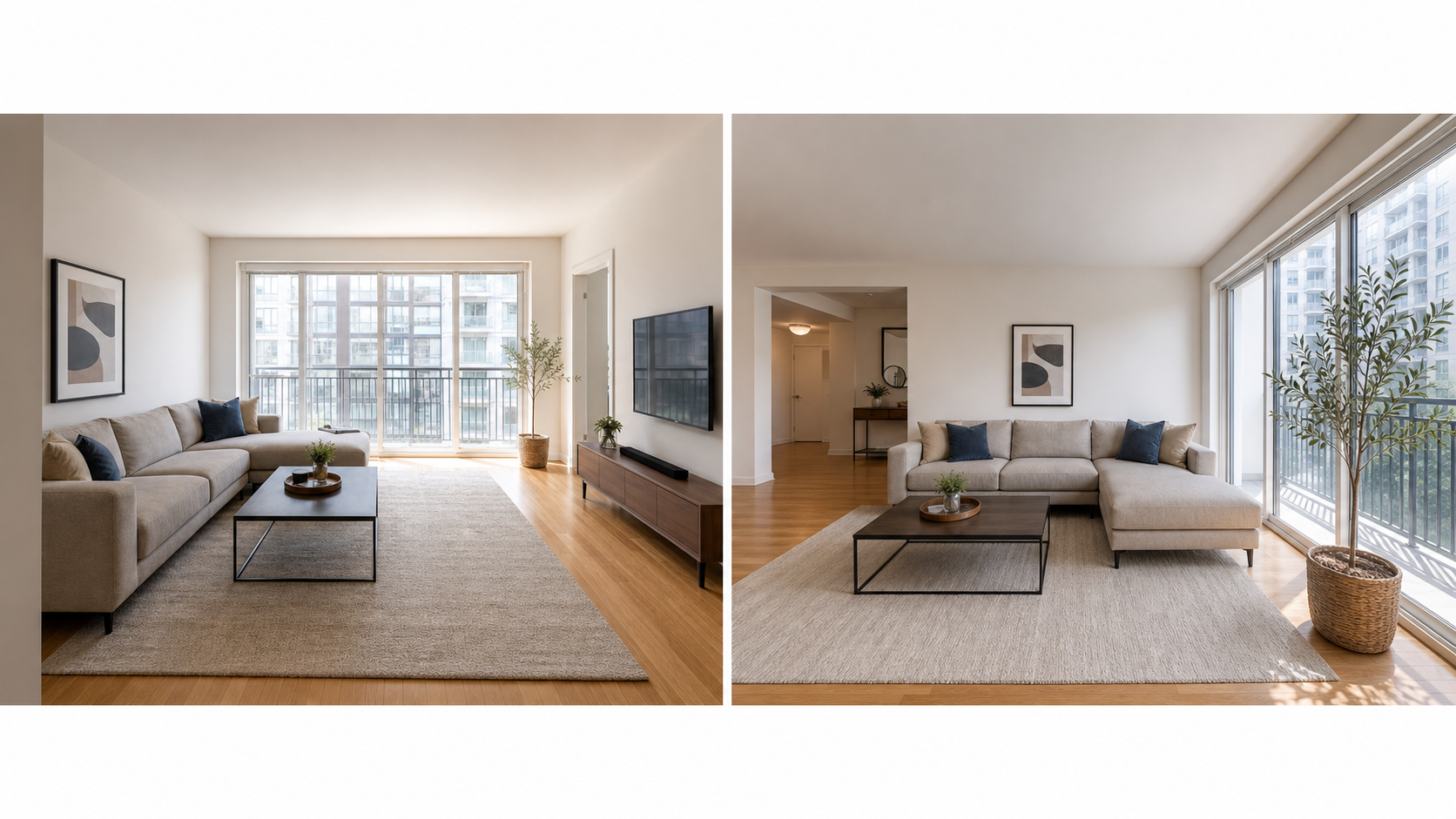
Should you stage physically or virtually?
Choose based on where the sale actually happens. Traditional staging improves both the photos and the in-person showing: buyers walk into furnished rooms that feel finished, and the marketing matches the experience. Virtual staging improves only the photos, at a fraction of the cost, which makes it a strong tool for getting clicks on a vacant listing and a weak one for the showing that follows, where buyers stand in empty rooms.
The honest framing is scope, not budget alone. If the listing will be shown vacant either way, labeled virtual staging can help buyers understand scale and purpose in the photos without pretending the furniture exists; the label handles expectations. If the property is a premium sale where showings decide everything, physical staging in the rooms that carry the tour usually earns its cost. Many listings sensibly do both.
How do the two approaches compare?
| Factor | Traditional staging | Virtual staging |
|---|---|---|
| Cost structure | Furniture rental, delivery, styling; typically ongoing for the listing period | Typically priced per photo, one-time |
| Speed | Days to schedule and install | Hours to a couple of days per batch |
| Photos | Real furnished rooms, no disclosure needed | Rendered furniture; must be labeled with originals available |
| Showings | Matches the photos; rooms feel finished | Vacant rooms; photos set expectations the tour must survive |
| Flexibility | Limited by inventory and layout | Any style, easy to redo for different buyer profiles |
| Best fit | Premium sales, occupied-look marketing, competitive markets | Vacant listings, budget-limited sales, remote sellers, concept marketing |
When does virtual staging make sense?
Virtual staging earns its place on vacant sale listings where the photo problem is emptiness. Empty rooms photograph poorly: they read smaller than they are, give buyers no sense of furniture scale, and make search-result thumbnails forgettable. A labeled staged render solves all three for the cost of an edit, which matters for estates, relocations, new construction without a model unit, and sellers who moved out before listing.
It also fits concept marketing: showing a buyer how a dated room could look, clearly framed as a possibility rather than the current state. What it does not fix is anything a visitor experiences: the echoing tour, the worn flooring, the dark hallway. Rules put guardrails on the tool everywhere it is used, so plan the label, the caption disclosure, and the original photo as part of the deliverable, not an afterthought.
When is traditional staging worth the cost?
Physical staging pays off when in-person impressions decide the sale. Competitive price points where buyers tour several similar homes, premium listings where presentation signals care, and vacant homes with awkward layouts that need furniture to explain all benefit from real staging. The staged home also feeds every downstream channel honestly: photos, video walkthroughs, twilight shots, and open houses all show the same finished rooms with no disclosure duties at all.
A practical middle path for most budgets: stage the living room, kitchen zone, and primary bedroom physically, since those rooms carry the tour, and leave secondary rooms empty or virtually staged with labels. Whatever you stage, photograph it properly, prepared rooms, daylight, level camera, and use honest touch-ups for lighting and color so the gallery does the staging justice.
What are the disclosure duties for staged photos?
Traditional staging needs no photo disclosure, since the furniture is really there. Virtual staging is a digitally altered image, and 2026 rules treat it that way. Most MLSs require a Virtually Staged label on the image or in the photo description, and many want the unstaged original included; CRMLS requires the original immediately before or after the altered photo. California's AB 723 requires a conspicuous disclosure on or adjacent to the image plus a link, URL, or QR code to the original for sale advertising. NAR's true-picture standard backs all of it. None of this makes virtual staging risky when done openly; it makes undisclosed staging indefensible.
Platform specifics are covered in virtual staging disclosure rules by platform.
How do you decide for your specific listing?
- Confirm how the property will be shown: vacant, occupied, or furnished for guests.
- List the rooms that will decide the sale or booking, usually living space, kitchen, and primary bedroom.
- Price physical staging for just those rooms and compare it to per-photo virtual staging for the rest.
- Check your MLS's staging label rules and, in California, AB 723 requirements before ordering renders.
- Photograph whatever is real with care, and enhance honestly: lighting, color, crop, and sharpness.
- Label every render, keep originals, and put the disclosure in the remarks as well.
For furnished rentals and short-stay listings, skip the staging question entirely and invest in the real setup. Property Photo AI's touch-up mode is built for that path: it makes photos of your actual rooms brighter, cleaner, and listing-ready without adding anything that would need a label.
FAQ
Is virtual staging cheaper than traditional staging?
Almost always. Virtual staging is typically priced per photo, while traditional staging involves furniture rental, delivery, and styling, often billed monthly for the life of the listing. The trade-off is that virtual staging only improves the photos, not the in-person showing.
Do buyers know when a photo is virtually staged?
They should, because staged images must be labeled under most MLS rules, and California's AB 723 requires disclosure plus access to the original photo. Buyers generally accept labeled virtual staging; what damages trust is discovering an empty or different-looking home without warning.
Does virtual staging work for rentals and Airbnbs?
It fits long-term rental marketing poorly and short-stay listings worse. Renters tour the real unit, and short-stay guests sleep on the actual furniture, so a staged image of furnishings that do not exist invites accuracy complaints. Furnished stays should photograph their real setup well.
Can I mix virtual and traditional staging?
Yes, and many sale listings do: physically stage the living room, primary bedroom, and kitchen where showings are won, then virtually stage secondary bedrooms or a bonus room, with labels. The showing still matches the marketing where it matters most.
What should never be changed in a staged photo?
Anything permanent or condition-related: walls, windows, flooring, fixtures, finishes, views, and any damage or wear. Staging adds furniture and decor to a truthfully rendered room. Editing the room itself moves the image from staging into misrepresentation territory.
How Property Photo AI helps
Property Photo AI helps landlords, Airbnb hosts, property managers, and real estate teams turn existing room photos into cleaner listing-ready images. It is built for realistic touch-ups: better light, color, crop, sharpness, and small-distraction cleanup without changing the actual room layout, fixtures, view, or condition.
Sources
- Airbnb Help Center: Taking great photos of your listing
- Airbnb Help Center: Setting up a photo tour for your home listing
- Airbnb Help Center: Add visual descriptions to photos in your listing
- Airbnb Help Center: Confirming photo accuracy for listings
- Airbnb Help Center: Offer for free Airbnb photography
- Google Business Profile
- Google Business Profile Help: Manage your hotel's details
- Booking.com Partner Hub: Understanding photo requirements for your property
- Booking.com Partner Hub: Improve visibility and ranking
- Vrbo Help: Photo guidelines
- Zillow Rental Manager Help: Photo Uploading Tips
- Zillow Rental Manager: Post a listing
- Zillow Rental Manager Help: Why is my primary photo different?
- Craigslist Help: Creating a posting
- Craigslist Help: Images
- Airbnb Help Center: Pricing your home listing
- Airbnb Help Center: Compare similar listings
- Airbnb Help Center: How search results work