
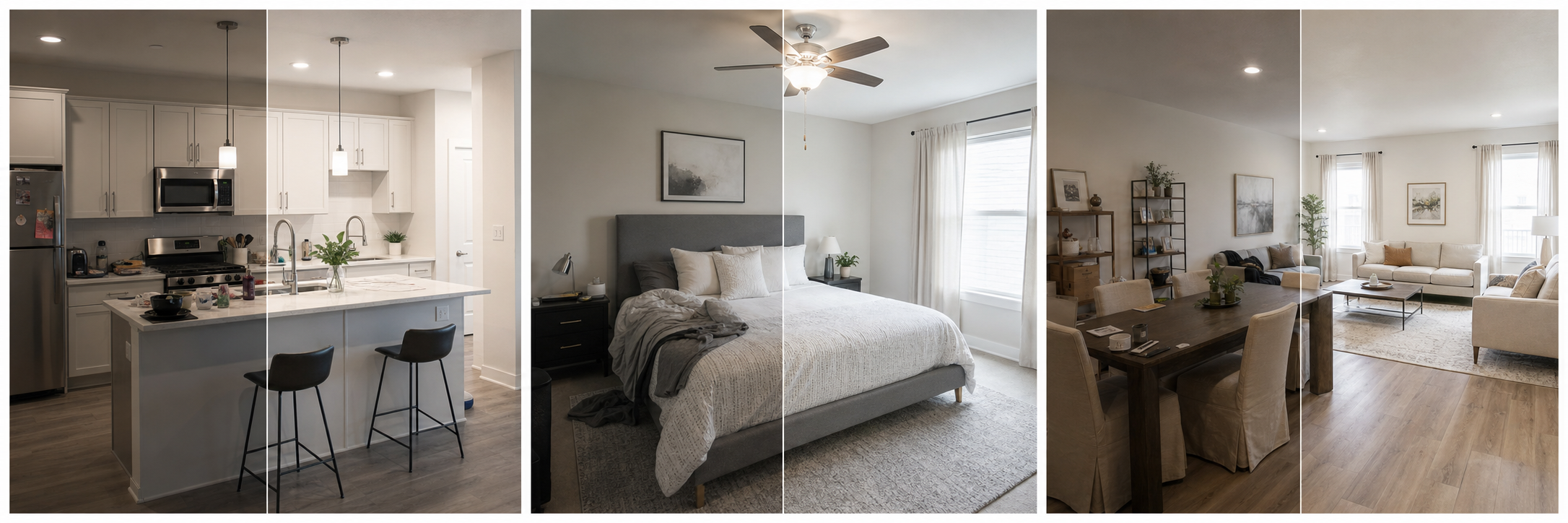
What makes an AI photo workflow disclosure-safe?
A disclosure-safe workflow guarantees two things: every published photo either required no disclosure or carries one, and you can prove it. The proof half matters as much as the label half. Since California's AB 723 took effect on January 1, 2026, licensees there must give buyers access to original, unaltered images whenever an ad uses digitally altered ones, and MLSs like CRMLS require originals placed immediately before or after altered photos. Even where no statute applies, NAR's true-picture standard and platform accuracy policies mean questions can always come later.
The workflow below adds roughly ten minutes per listing. It front-loads the boring parts, archiving and labeling, so that no future complaint, audit, or guest dispute can turn a marketing decision into a credibility problem. Hosts and agents who follow it can use AI tools aggressively for quality and still answer every accuracy question with a folder and a sentence.
What should you do before editing any photos?
- Create a dated originals folder per listing and copy every unedited photo into it before touching anything.
- Note the platform destinations for the gallery, since MLS, Airbnb, Vrbo, and Zillow have different rules.
- Look up your MLS's altered-image policy and, in California, the AB 723 requirements.
- Fix the property, not the photo: remove real clutter, repair what should be repaired, stage physically where possible.
- Decide up front which images, if any, will be deliberately altered, such as virtual staging of an empty room.
Deciding alteration up front is the step most people skip. When alteration is a plan instead of a temptation inside an editing tool, the label and the original get planned with it.
Which edits need a label and which do not?
Use this quick reference when reviewing each finished image. The test behind every row: does the photo still show what a visitor would see standing in the space?
| Edit you made | Label needed? | Notes |
|---|---|---|
| Exposure, brightness, white balance, color | No | Exempt under AB 723 and standard MLS policy when the room still reads true |
| Crop, straighten, correct angle, sharpen | No | Exempt routine editing |
| Remove a temporary object (cord, bin, car in driveway) | Judgment call | Safe when the object leaves with the seller or host; log it |
| Virtual staging or furniture removal | Yes | Label on or adjacent to the image; include or link the original |
| Sky replacement or virtual twilight | Yes, treat as altered | It changes how the scene is represented; label it and keep the original |
| Change finishes, fixtures, landscaping, or views | Do not publish | Misrepresentation risk regardless of label; use only in clearly labeled renovation concepts |
| Remove damage, stains, or wear | Do not publish | Condition is a pertinent fact; never edit it out of listing photos |
How should you label and place disclosures?
Make the label impossible to miss and boring to read. Under AB 723 the statement must be reasonably conspicuous and located on or adjacent to the image, with a link, URL, or QR code to the original. CRMLS's implementation is a good national template even outside California: use plain terms like Virtually Staged or Digitally Enhanced in the photo description, and position the unaltered original immediately before or after the altered image. Repeat the disclosure once in the listing remarks so it survives syndication to portals.
Two platform cautions. Vrbo rejects photos with text overlays and watermarks, so on-image badges are unavailable there, which is one more reason virtual staging fits poorly on short-stay listings. And Airbnb's accuracy expectations mean the best disclosure on a short-stay listing is a gallery that never needs one: photograph the real furnished space and enhance honestly.
Background on the rules is in our AI disclosure guide and the platform-by-platform breakdown.
What should the final pre-publish review cover?
- Open originals and edited photos side by side and confirm each edit matches its log entry.
- Apply the standing-in-the-room test to every image, especially bathrooms, views, and room sizes.
- Confirm every altered image has its label, its adjacent or linked original, and a remarks-level disclosure.
- Check platform specifics: MLS photo descriptions, Airbnb captions, Vrbo overlay rules.
- View the live listing on each platform and verify labels rendered where viewers will see them.
- Archive the whole set, originals, edits, log, and screenshots of the live listing.
Property Photo AI fits this checklist as the touch-up engine: it improves lighting, color, crop, and sharpness while preserving the real layout, fixtures, views, and condition, so its output lands in the no-label rows by design. Whatever mix of tools you use, the checklist is the product: honest photos, labeled alterations, and a paper trail. This is general information, not legal advice.
FAQ
What does disclosure-safe AI enhancement mean?
It means editing listing photos in a way that either needs no disclosure because only lighting, color, crop, straightening, and sharpness changed, or is properly labeled with access to originals when real elements were added, removed, or changed. Either state is safe; the unsafe state is unlabeled alteration.
Why should I keep original photos if I only do touch-ups?
Originals are your proof. If a buyer, guest, MLS, or regulator ever questions an image, the original shows the edit changed presentation rather than substance. In California, licensees must provide access to originals for altered images, and originals cost nothing to keep.
Do I need an edit log for every photo?
A simple note per photo, such as exposure, white balance, crop, takes seconds and answers most questions before they escalate. For altered images like virtual staging, a log is close to essential because it documents exactly what was added or changed.
Which label wording should I use?
Follow your MLS's format first. Widely accepted wording includes Virtually Staged, Digitally Altered, or Digitally Enhanced placed on or adjacent to the image and repeated in the caption or remarks. Vague wording like Artist's Impression buried in fine print does not meet the conspicuous standard.
Does this checklist replace legal advice?
No. It is a practical workflow based on published laws, MLS policies, and ethics rules as of mid-2026. Requirements differ by state, board, and platform and continue to evolve, so confirm specifics with your broker, MLS, or attorney.
How Property Photo AI helps
Property Photo AI helps landlords, Airbnb hosts, property managers, and real estate teams turn existing room photos into cleaner listing-ready images. It is built for realistic touch-ups: better light, color, crop, sharpness, and small-distraction cleanup without changing the actual room layout, fixtures, view, or condition.
Sources
- California AB 723: Real estate: digitally altered images: disclosure (bill text)
- CRMLS Knowledgebase: California's Altered Image Law (CA AB 723) FAQs
- NAR: 2025 Code of Ethics and Standards of Practice
- NAR: Using AI to Enhance Listing Photos Can Be Legally Risky
- Airbnb Help Center: Confirming photo accuracy for listings
- Vrbo Help: Photo guidelines