
Why does photo accuracy matter so much on Airbnb?
Every listing photo is a promise about a stay the guest cannot inspect in person. The guest is buying a future night in a stranger's property, sight unseen, so the gallery carries the whole burden of proof. When photos are accurate, guests can move from doubt to decision: they know what the bedroom looks like, whether the bathroom feels clean, whether the kitchen works for their trip, and whether the workspace or outdoor area is real. When photos oversell, the booking may still happen, but the stay begins with disappointment, and disappointed guests write the kind of reviews that suppress bookings for months. Accuracy is therefore not the opposite of good marketing; it is what makes good marketing sustainable. A photo set that is both attractive and true compounds; a flattering but misleading one decays.
What does Airbnb say about photo accuracy?
Airbnb's guidance is consistently accuracy-first: guests should get what the photos promise. Its host guidance pairs quality advice, landscape images of at least 1024x683 pixels, clean and clutter-free spaces, daylight, with an emphasis on photos reflecting the real stay, and its photo-tour guidance expects each room or space to have at least one photo. Airbnb also encourages objective visual descriptions, which help guests using screen readers and guests on slow connections understand what each image actually shows. The pattern is a strong hint about what the platform and its guests reward: complete coverage, honest presentation, and photos that survive comparison with reality at check-in. Hosts sometimes read platform guidance as a hoop to jump through, but here it is closer to a description of how good reviews get made.
What does an accurate photo set look like in practice?
Accurate photos show the current furniture, the real bedding setup, actual window views, true room proportions, and the amenities guests filter for. They include the unglamorous but decision-relevant shots, the compact second bathroom, the stairs to the loft, the parking situation, instead of quietly omitting them. They avoid extreme wide-angle lenses that stretch rooms, heavy filters that change the feel of the light, and seasonal photos that no longer match the property. Accuracy also means currency: if you replaced the sofa, repainted, or lost the tree that shaded the patio, the gallery should catch up. A useful habit is re-walking the listing with the gallery open once or twice a year and flagging every photo a guest could reasonably dispute on arrival.
Which edits build trust and which break it?
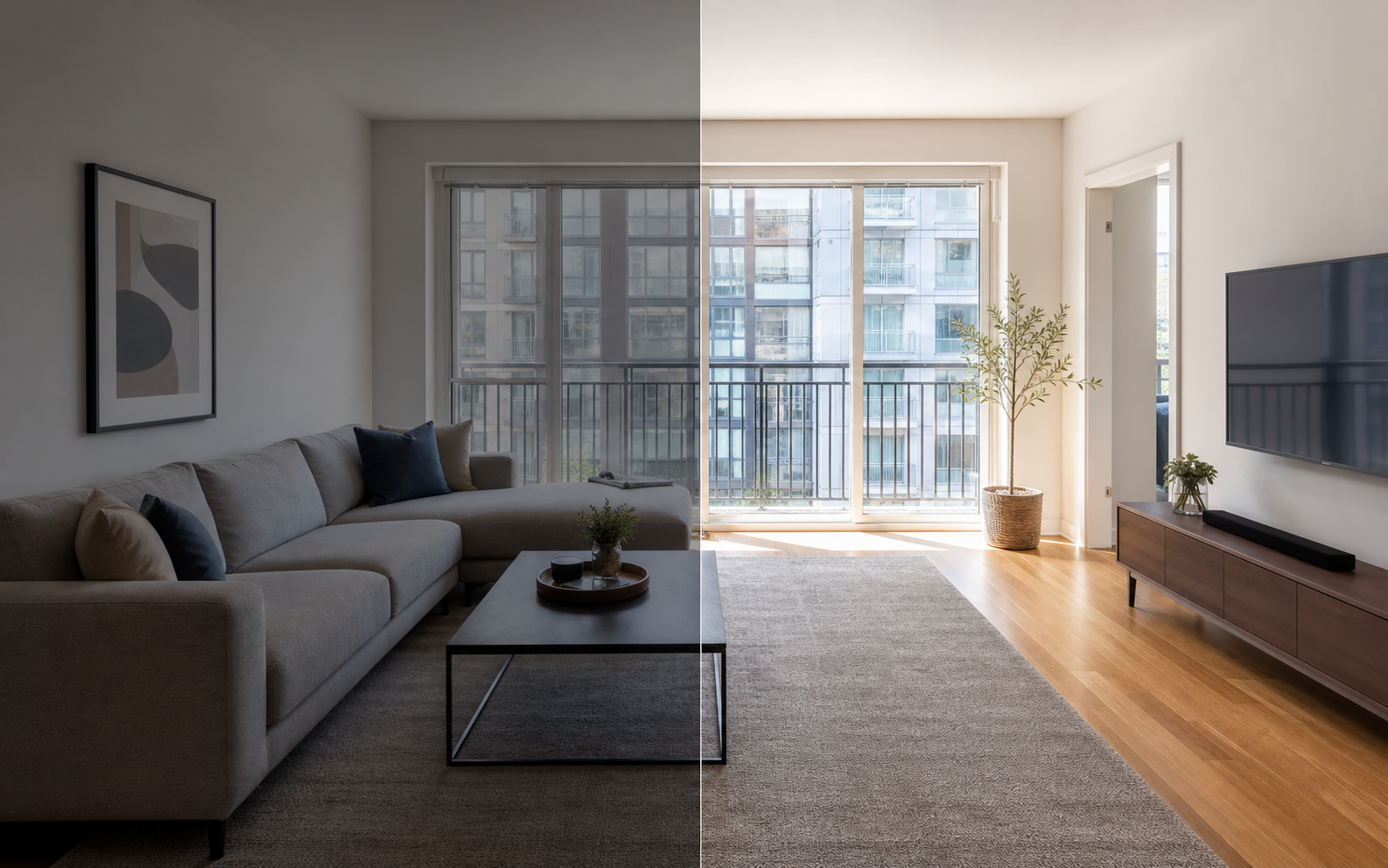
The distinction is not between edited and unedited photos; nearly every good listing photo is edited. The distinction is between corrections that help guests see the real space clearly and alterations that change what the space appears to be. Corrections reduce noise; alterations manufacture a different property. If you market real estate rather than a short-term rental, note that some jurisdictions now regulate this line explicitly, including California's AB 723 disclosure rules for licensees, covered in our disclosure guide.
| Edit | Verdict | Why |
|---|---|---|
| Brightening a dark room | Fine | Shows the real space more clearly |
| Fixing color casts | Fine | Restores true colors |
| Cropping and straightening | Fine | Presentation, not misrepresentation |
| Removing a stray bin or cable | Usually fine | Temporary clutter, not a feature |
| Erasing stains, damage, or wear | Avoid | Hides what guests will find |
| Enlarging rooms or enhancing views | Avoid | Changes the promise itself |
| Adding furniture or amenities | Avoid | Invents features that do not exist |
For the platform-rules side of this line, see when edited listing photos need disclosure and AI editing versus misrepresentation.
How do you audit your own listing for accuracy?
An accuracy audit works best as a physical walkthrough with fresh eyes, ideally after a gap away from the property or with help from someone who has never stayed there. You are hunting for gaps between the gallery and the ground truth, in both directions: photos that flatter beyond reality, and real strengths the gallery undersells.
- Open your listing gallery and walk the property room by room, comparing each photo to the space.
- Flag any photo showing furniture, decor, or views that have changed.
- Flag any edit that hides damage, wear, or a permanent drawback.
- Check that every room and bookable amenity has at least one current photo.
- Reread recent reviews for accuracy complaints and fix what they mention first.
- Reshoot or honestly re-edit the flagged photos.
- Update visual descriptions so they objectively match the new images.
What is a safe editing standard you can apply every time?
Adopt one standing rule: an edit is safe when the guest standing in the room would agree the photo was fair. That standard permits everything that makes photos clearer, better exposure, natural color, level lines, sharpness, tidy crops, and small cleanup of temporary clutter, while ruling out anything that would make check-in feel like a downgrade. Tools matter here because they encode defaults. Property Photo AI's touch-up mode is built around this standard: it improves lighting, color, crop, and sharpness while preserving the real layout, fixtures, and views, and its new-angle mode works only from your real reference photos rather than inventing spaces. Whatever you use, apply the fairness test to every output. Trust is slow to earn in a review profile and fast to lose, and the gallery is where guests decide which kind of host you are.
FAQ
Why does photo accuracy matter on Airbnb?
Guests use photos to decide whether the stay matches their needs, and Airbnb emphasizes that guests should get what the photos promise. Inaccurate photos create arrival disappointment, which shows up in reviews and hurts future bookings more than honest photos ever would.
Can hosts edit Airbnb photos at all?
Yes. Routine corrections like brightness, white balance, cropping, straightening, and sharpening are normal presentation work. The line is edits that change what a guest will actually find: invented features, removed defects, exaggerated space, or views that do not exist.
What is a simple test for an honest edit?
Ask whether the edited photo would still feel fair to a guest standing in the room. If the answer is yes, the edit supports trust. If the photo would create surprise at check-in, it is trading long-term reviews for short-term clicks.
Do trust problems show up in reviews?
Often, yes. Guests who feel misled tend to mention it, and accuracy complaints are among the most damaging review themes because they warn future guests not to believe the gallery. Accurate photos are a defensive investment in your review score.
How Property Photo AI helps
Property Photo AI helps landlords, Airbnb hosts, property managers, and real estate teams turn existing room photos into cleaner listing-ready images. It is built for realistic touch-ups: better light, color, crop, sharpness, and small-distraction cleanup without changing the actual room layout, fixtures, view, or condition.
Sources
- Airbnb Help Center: Taking great photos of your listing
- Airbnb Help Center: Setting up a photo tour for your home listing
- Airbnb Help Center: Add visual descriptions to photos in your listing
- Airbnb Help Center: Confirming photo accuracy for listings
- Airbnb Help Center: Offer for free Airbnb photography
- Google Business Profile
- Google Business Profile Help: Manage your hotel's details
- Booking.com Partner Hub: Understanding photo requirements for your property
- Booking.com Partner Hub: Improve visibility and ranking
- Vrbo Help: Photo guidelines
- Zillow Rental Manager Help: Photo Uploading Tips
- Zillow Rental Manager: Post a listing
- Zillow Rental Manager Help: Why is my primary photo different?
- Craigslist Help: Creating a posting
- Craigslist Help: Images
- Airbnb Help Center: Pricing your home listing
- Airbnb Help Center: Compare similar listings
- Airbnb Help Center: How search results work